

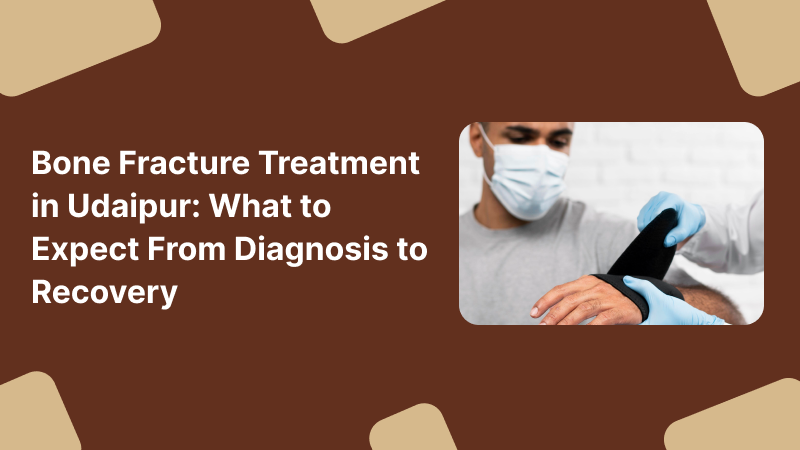
A bone fracture can happen after a fall, road accident, sports injury or direct impact. In people with weak bones, even a minor incident may cause a fracture.
Pain and swelling are common signs, but every fracture does not look the same. Some fractures cause an obvious deformity, while others appear similar to a sprain. Prompt medical evaluation helps identify the injury and begin suitable bone fracture treatment in Udaipur.
Common signs of a bone fracture
Possible symptoms include:
- Severe pain after an injury
- Swelling or bruising
- Difficulty moving the injured area
- Inability to stand or bear weight
- Visible deformity
- Tenderness around the bone
- A grinding sensation during movement
Do not attempt to straighten a suspected fracture yourself.
When is emergency care required?
Seek immediate medical attention if:
- The bone has broken through the skin
- There is heavy bleeding
- The limb appears bent or deformed
- Fingers or toes become pale, blue, cold or numb
- The person cannot move the injured limb
- The injury involves the head, neck, spine or pelvis
- The fracture follows a major road accident or fall
Keep the injured area still while arranging medical assistance. If a bone is visible, do not push it back inside. Open fractures require urgent care because of the risk of bleeding and infection.
How is a fracture diagnosed?
An orthopaedic doctor will ask how the injury occurred and examine the affected area for pain, swelling, movement, circulation and nerve function.
An X-ray is commonly used to confirm the fracture and identify its location and pattern. A CT scan or MRI may be advised for complex injuries or when more detailed information is required.
Types of bone fracture treatment
Treatment depends on the affected bone, fracture pattern, displacement, age and overall health of the patient.
Cast or splint
A splint or cast keeps the injured bone stable while it heals. This is commonly used when the broken ends remain properly aligned or can be repositioned without surgery.
Closed reduction
If the bone has moved out of position, the doctor may carefully realign it without making a surgical incision. A cast or splint is then applied to maintain alignment.
Fracture surgery
Surgery may be required when the fracture is displaced, unstable, open or involves a joint. Plates, screws, rods or other implants may be used to hold the bone in the correct position.
Not every fracture requires an operation. Many broken bones heal successfully after proper realignment and immobilisation.
What happens during recovery?
Recovery usually includes several stages:
- Protection: A cast, splint or surgical implant keeps the bone stable.
- Follow-up: The doctor may use repeat X-rays to monitor alignment and healing.
- Gradual movement: Joint movement may begin when considered safe.
- Physiotherapy: Exercises help restore flexibility, strength and balance.
- Return to activity: Normal work, driving and sports are resumed gradually.
Avoid putting weight on the injured area until your doctor permits it. Returning to activity too early can delay healing or move the fracture out of alignment.
How long does a fracture take to heal?
Healing time varies according to:
- The bone involved
- Type and severity of the fracture
- Patient’s age
- Blood supply to the injured area
- Nutrition and general health
- Smoking or tobacco use
- Infection
- Adherence to treatment advice
Some fractures heal within several weeks, while complex injuries can require months of treatment and rehabilitation.
Supporting bone healing
Patients can support recovery by:
- Taking medicines as prescribed
- Keeping follow-up appointments
- Following weight-bearing restrictions
- Performing only approved exercises
- Eating a balanced diet with adequate protein
- Avoiding smoking and tobacco
- Keeping a cast or wound clean and dry
Contact your doctor if pain or swelling suddenly worsens, the cast feels unusually tight or the fingers or toes become numb, cold or discoloured.
Returning to normal activity safely
Feeling better does not always mean the bone has completely healed. Strength and movement may take additional time to return after the fracture unites.
An orthopaedic doctor or physiotherapist can guide the safe return to walking, work, driving and sports. The process should be gradual and based on clinical assessment rather than pain alone.
Timely bone fracture treatment in Udaipur can help stabilise the injury, reduce complications and support a structured recovery. The exact treatment must always be personalised according to the fracture and the patient’s overall condition.
FAQs
Does every fracture require a plaster cast?
No. Treatment may involve a splint, cast, brace, closed reduction or surgery depending on the fracture.
Does every broken bone need surgery?
No. Many fractures can heal without surgery when the bone remains properly aligned and stable.
How is a fracture confirmed?
An X-ray is commonly used. CT or MRI scans may be recommended for certain complex injuries.
When can I walk after a fracture?
The timing depends on the injured bone and its healing progress. Do not bear weight until your orthopaedic doctor allows it.
Is physiotherapy necessary after a fracture?
It is often helpful for restoring movement, strength and balance, especially after prolonged immobilisation or surgery.
